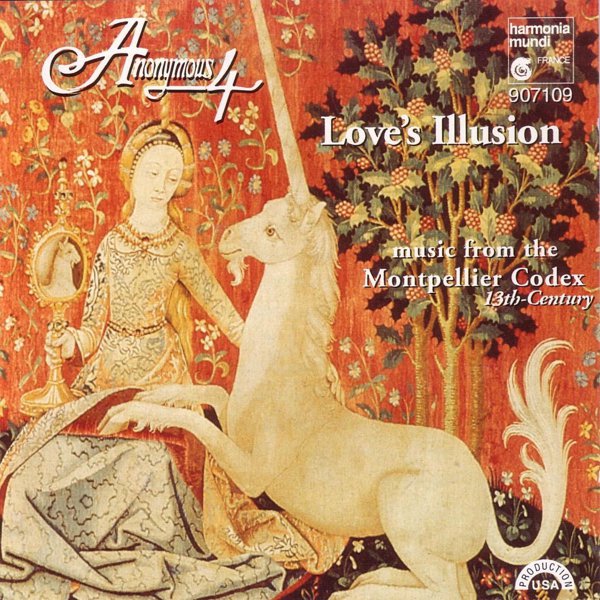
Love’s Illusion (Music From The Montpellier Codex 13th-Century) cover

Love’s Illusion (Music From The Montpellier Codex 13th-Century)

Released

The Montpellier Codex is the most famous collection of polyphony from the 13th century, and Anonymous 4’s is the most successful, satisfying contemporary animation of it. The short motet, “Ne sai que je die,” for instance, showcases the group’s athletic unison singing. It is one of many pieces from the Codex that become easily digestible in the hands of Anonymous 4. Those seeking complexity, though, will also find it here, as these pieces often pile melodies, texts, and meanings into single, compressed wholes.

Sean Wood

Suggestions
Aleotti: Le Monache di San Vito cover

Aleotti: Le Monache di San Vito

Candace Smith, Cappella Artemisia
French Chansons cover

French Chansons

Claudin De Sermisy, Clément Janequin, Josquin Des Prez, Roland De Lassus, Scholars of London, The Scholars
Kindertotenlieder cover

Kindertotenlieder

Bruno Walter, Kathleen Ferrier, Wiener Philharmoniker
Stravinsky: Symphony of Psalms cover

Stravinsky: Symphony of Psalms

Berlin Philharmonic Orchestra, Pierre Boulez
Hildegard Von Bingen: Heavenly Revelations cover

Hildegard Von Bingen: Heavenly Revelations

Oxford Camerata, Jeremy Summerly
The Glory of Gabrieli cover

The Glory of Gabrieli

E. Power Biggs, Texas Boys' Choir, The Edward Tarr Brass Ensemble, The Gregg Smith Singers, Vittorio Negri
First Drop cover

First Drop

Ars Nova Copenhagen
Julia Wolfe: Fire in My Mouth cover

Julia Wolfe: Fire in My Mouth

Jaap van Zweden, New York Philharmonic
Choruses And Chorales From J.S.Bach: St Matthew Passion cover

Choruses And Chorales From J.S.Bach: St Matthew Passion

Monteverdi Choir, English Baroque Soloists, John Eliot Gardiner